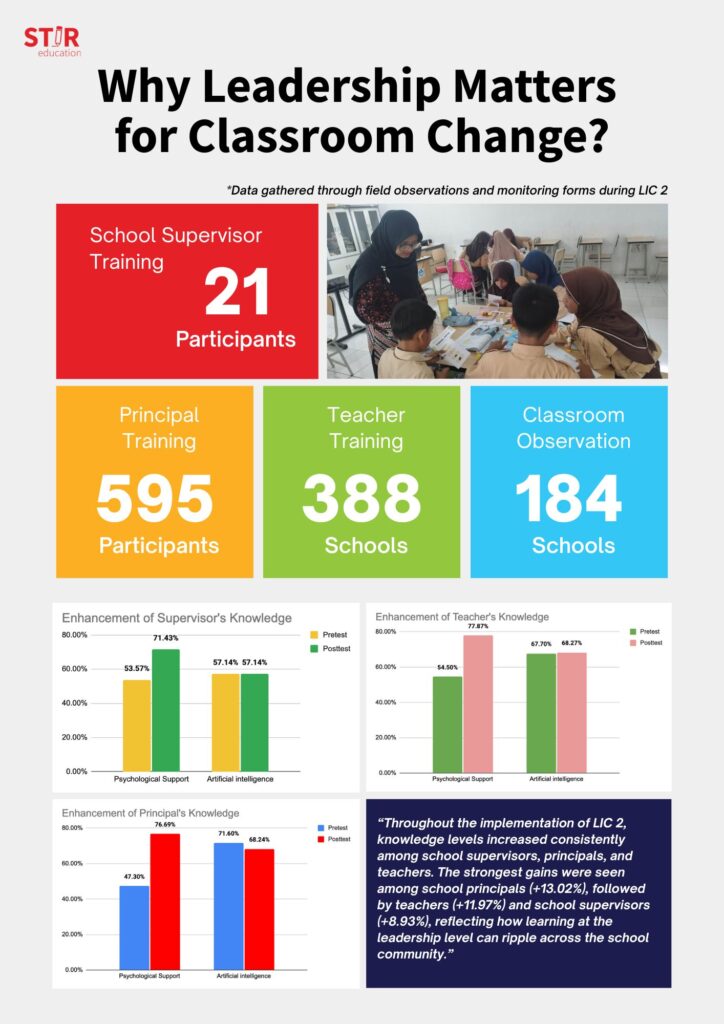
The Second Learning Improvement Cycle (LIC 2) in Garut District has now been completed. Through this process, we gathered not only field stories but also data that helps illustrate how change has begun to take shape in schools.
A total of 595 school principals across 21 sub-districts participated in the SPP 2 training. This shows that nearly all target schools were reached at the leadership level. However, participation in training alone does not automatically lead to change in classroom practice.
So, what happened next? From these principals, 388 schools continued to the teacher training stage. Furthermore, 184 schools took the next step by conducting classroom observations as a concrete follow-up. This means that almost half of the schools that joined teacher training chose to move beyond understanding and into practice.
At this point, an important question emerged: why were some schools able to move into practice, while others were not?
Field experience points to one clear factor: the role of the school principal. Classroom practice is unlikely to change unless school leadership moves first. Without a sense of safety created by leadership, teachers tend to hesitate to open their classrooms for observation and reflection. Without principals who are willing to learn alongside teachers, training risks becoming a procedural activity rather than a meaningful process.
On the other hand, when principals take the first step, engaging teachers in discussion, giving them space to try new approaches, and viewing observation as a shared learning process, classrooms gradually become spaces for reflection. This is where changes in teaching practice begin to take root.
Our work in Garut shows that educational change is not simply about how many trainings are delivered, but about who is mobilized first. When principals move, schools are more likely to move with them. And when schools begin to move, change in the classroom becomes not just a possibility, but an ongoing process.