
At the beginning of the school year, only 12 of the 98 Primary Two learners in Caroline Adongo’s class could correctly identify basic letter sounds.
For the children who learned more slowly, keeping up was difficult. In a classroom with nearly 100 learners, some moved quickly while others needed more time and support.
“Most times, those learners would be left behind,” Caroline recalls.
Caroline knew she needed to teach differently.
Like many teachers, she had been accustomed to standing at the front of the classroom, explaining concepts while learners listened. But this approach offered limited opportunities for children to practice, ask questions, support one another or learn at their own pace. The challenge was not simply to improve literacy. It was to ensure that every child had a genuine opportunity to learn.
That journey began when Caroline joined the Special Project, funded by Social Initiative, a teacher development initiative supporting teachers to make their classrooms more inclusive and learner-centred. Over 12 months, the programme reached more than 1,000 teachers across 80 schools in Kaberamaido District through teacher network meetings, peer coaching and classroom observation and feedback.
For Caroline, the learning became real when she began receiving feedback on what was actually happening in her classroom. Through classroom observations and reflective conversations, she started experimenting with interactive storytelling, peer learning and simple teaching and learning materials made from locally available resources.
Her practice was further strengthened through School Education Leader Institutes focused on improving literacy achievement. These sessions introduced practical techniques in phonemic awareness, sound blending, pronunciation and reading fluency.
“The programme changed how I engage learners. The literacy training then gave me additional tools to help them develop their reading skills. Together, they have made my lessons practical and participatory,” says Caroline.
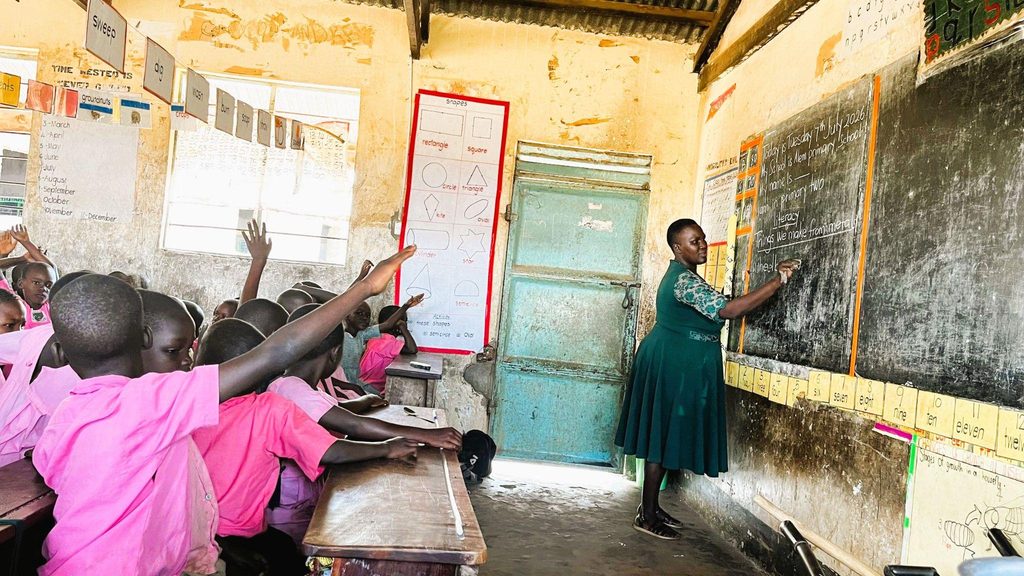
A classroom where children participate
Today, Caroline’s classroom feels different.
During a recent literacy lesson, she introduced the “Box of Sounds” game. Learners picked letter cards from a box, identified individual sounds and blended them to form words. Children supported one another, and those who previously struggled had more opportunities to practise without fear of getting an answer wrong.
One learner, Emmanuel, remembers how different things used to feel:
“I used to hide my face when the teacher called my name because I couldn’t read the words. Now we play the sound box game and the Bingo game together, and I can read out loud to my friends.”
The change is also visible in the results. By Term II of 2026, 68% of learners were able to blend sounds to form words, compared with a baseline of 21% at the beginning of the programme. During a recent observed lesson, 67 of the 98 learners present successfully blended multi-syllable words and read simple sentences aloud.
But perhaps the most encouraging change is that Caroline’s learning is no longer contained within her classroom. Supported by her headteacher, she is now co-planning lessons with other lower-primary teachers and sharing active-learning approaches during staff reflection sessions.
“We have seen Caroline become far more deliberate in how she involves learners, particularly those who previously struggled,” says Ms. Ajilo Jane, Headteacher Alem Primary School. “She is now sharing these approaches across our lower-primary department, helping us rethink how we teach literacy across the entire school.”
Caroline’s story is a reminder that meaningful education change often begins with something simple: a teacher trying a new approach, a child finding the confidence to participate, and a school creating space for teachers to learn from one another.
When teachers are supported with practical skills, opportunities to reflect and the encouragement of their peers and school leaders, classrooms can become places where fewer children are left behind and more children find their voice, their confidence and their ability to learn.