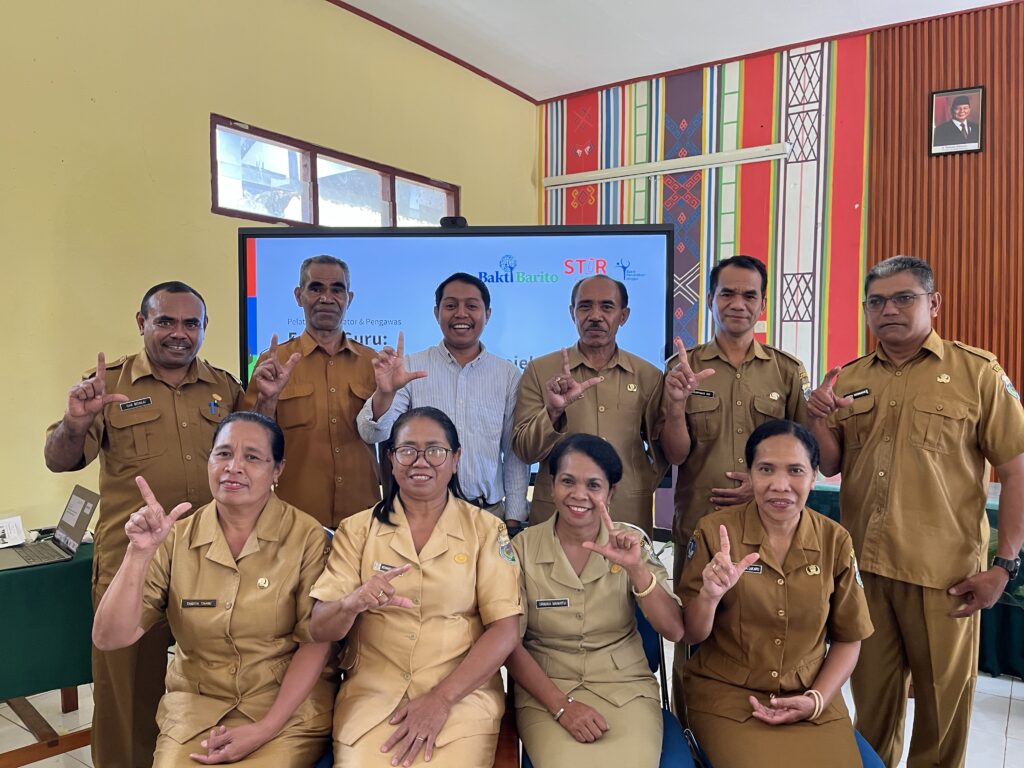
That morning in Soe felt different.
After days of rain and cloudy skies, the sun finally appeared above SD Inpres Taubnen In the school assembly hall usually filled with students’ voices, school supervisors and sub-district facilitators gathered for a different purpose: to reflect, question, and improve the learning materials that will soon be used across Timor Tengah Selatan, Malaka, and Timor Tengah Utara, East Nusa Tenggara Province.
This meeting was part of STiR Education’s Learning Improvement Cycle (LIC) 3, where stakeholders are not only recipients of materials, but active contributors. Through open discussion, participants reviewed the Keterampilan Bertanya Efektif and Project Based Learning (PjBL) modules and shared honest feedback from their field experiences.
Pak Simon Nenobais, one of the supervisors, shared, “This activity is very meaningful for us because we feel involved in reviewing the materials that will later be implemented.”
Ibu Ori, a school principal and sub-district facilitator, added, “Through this session, we can give real input. The materials are very relevant, especially PjBL, because they start from real problems around the school environment.”
Participants agreed that both materials were easy to follow, aligned with current education policies, and realistic to apply. The discussion also revealed a key insight: two-way communication during mentoring often fails because we rely too much on closed-ended questions. This realisation opened a new perspective on how supervisors and principals can guide teachers more effectively.
For PjBL, the material was seen as clear and suitable for the local context, though teachers still need support in choosing meaningful big themes. Participants recommended adding more contextual examples and hands-on practice in future sessions.
As the meeting closed, there was a shared sense of ownership. The feedback would return to the STiR team, and facilitators would begin redesigning lesson plans using the 3T approach.
In that small hall in Soe, system learning did not feel distant. It felt real, grounded, and shared.